 Sheaf
Sheaf
Opens the review room.
Clicks a figure, lands on the page it was read from, approves it.
The wet‑ink scans. The package of 32 docs merged into one PDF. The phone photos of IDs. Drop the whole thing in.
or click to choose
Multiple PDF, PNG, JPEG & TIFF acceptedSelecting files opens your OS picker. Processing continues in Sheaf. No files are uploaded from this page.
Engineered for:






One PDF goes in. Sheaf finds where each document starts and ends, names it, and checks it against your expected document list. You get a manifest — 43 documents, their page spans, what is missing — before a single field is read.
You are never billed for reading a pile you would have rejected on sight.
An expected document list is a checklist of document types, each with a schema — the fields Sheaf should pull from that type. Every document found in the packet is matched to the checklist, then read for its fields. Whatever is missing gets named: no certificate of insurance in the packet, no ending balance on a bank statement.
Expected documents Purchase loan · California
Schema Bank statement
Change the list and the whole corpus re‑scores against it. Nothing is read twice.
Every value carries its page and a four‑number box — $9,502.93, page 3 of 6. Any number drills straight back to the pixel it was read from.
What comes back for one field
Absence is a value. A field your schema asked for and the document did not contain comes back marked not‑stated. You can query it.
Three decisions per document — page span, requirement match, field values — each confirmed or redirected from the keyboard. Redirects are the training signal.
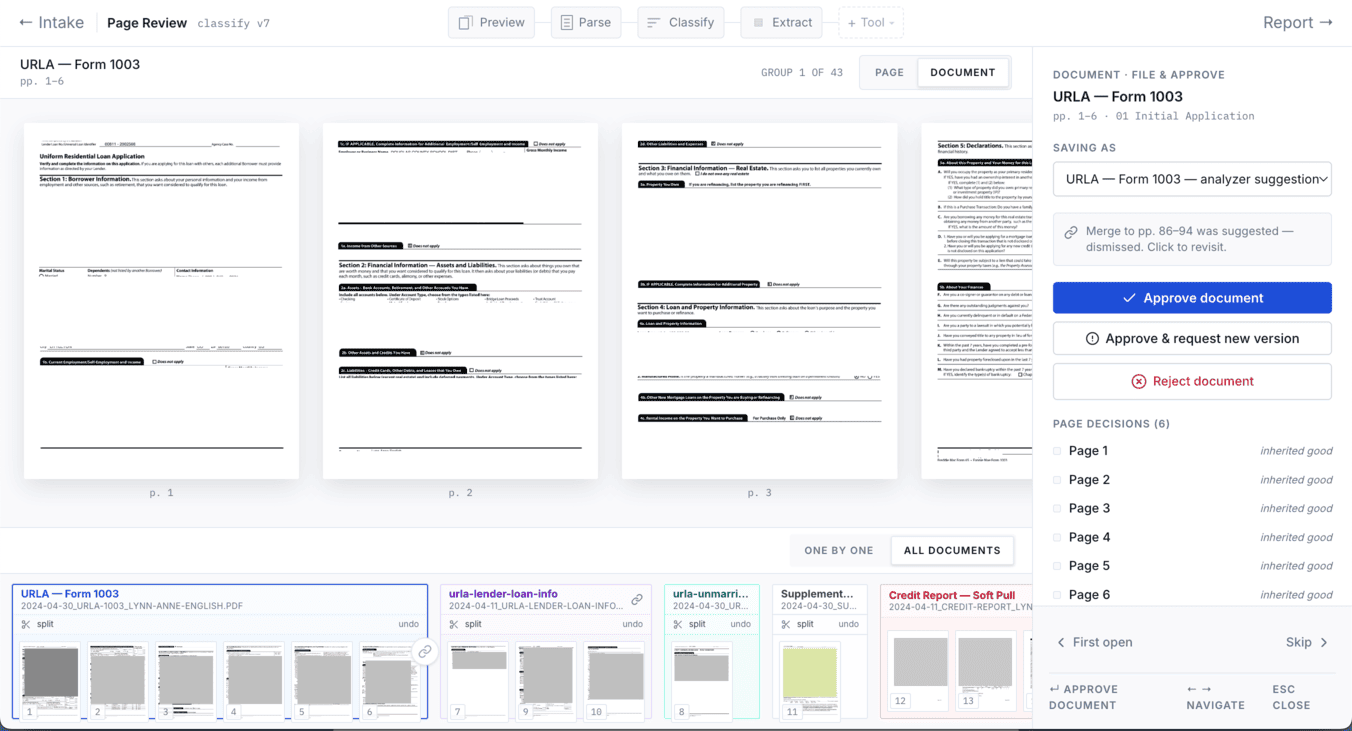 Every stage on one screen
The scan itself, not a summary
Approve, or send it back
A decision on every page
43 documents, re‑cuttable
Every stage on one screen
The scan itself, not a summary
Approve, or send it back
A decision on every page
43 documents, re‑cuttable
Pick a packet and it opens in the review room, in a new tab, already analyzed. Approve, reject, re‑file, ask the assistant. No form to fill in: a workspace of your own is made as you click, and this page stays where it is.
Every correction is kept with who made it, what the engine proposed, and the pages it covered. Where the human departed from the machine is the signal. Two independent reviewers agreeing promotes a rule. One person clicking forty times does not.
Learned from your reviewers 1,140 decisions
What is learned stays inside your organisation and is never pooled.
Reading already happened, so a question is a lookup. What is missing, where two documents disagree, what your own average is — 3,914 files, 61 milliseconds.
Where were we invoiced above the rate we signed?
6 discrepancies · 3,914 files read$16,765 · 61 ms
The model receives two kilobytes of facts instead of four hundred pages. Reading ten thousand files to answer the same question would be two billion tokens.
Sheaf ends in the corpus. A person, an agent, or your own software asks the same question and gets the same answer, with the same pages behind it. No seat to buy.
Clicks a figure, lands on the page it was read from, approves it.
Claude, Codex, whatever you already run. Same corpus, same citations, no account for you to administer.
sheaf ask "missing COI on open work orders"
No session to keep alive, no browser, no seat to buy.
GET /api/data/query?q=…
All three get the same answer
Yes — 3 of 208 invoices billed above their agreed rate.
An answer, with the pages it stands on.
Point it at the pile. That is the whole configuration.
Every extracted value carries the file, page and span it came from. An answer you cannot walk back to the page is an answer you cannot defend.
Real work arrives as a scan of a print of a fax. A page with no text layer is the ordinary case here, not the exception that gets routed to a person.
Completeness is the question most systems never answer. Sheaf names the requirement that nothing satisfied, which is usually what is holding the file up.
Every automatic outcome points back at the human decisions behind it, so an auditor can walk from a value to a page without leaving the record.
Every request is checked against the role that made it, records age out on a fixed retention window, and each value stays traceable to its page.